

Texas BEAD Broadband: What It Means for Rural Communities
Updated October 21, 2026. Rural Texas communities have the awards on paper. Until the hold clears, the useful work is getting ready locally.
Texas BEAD broadband at a glance
- Awards: Final BEAD awards go to 17 providers for more than 208,000 locations, about $1.07 billion.
- Scaled back: That is about 84 percent of the $1.27 billion in provisional awards; about 31,000 locations lost a planned provider when four winners backed out.
- On hold: In August 2026 the Broadband Development Office paused BEAD disbursements until further notice.
- What that means: Construction timing in Texas is uncertain. Check the state office for current status.
Where Texas’s BEAD plan stands
Texas has the largest BEAD allocation in the country and is one of the harder places to forecast. The state finalized subgrantee agreements with 17 providers covering more than 208,000 locations. Provisional awards in October 2025 had been about $1.27 billion for 240,205 locations; final awards came to about $1.07 billion for 208,873.
The gap exists because four tentative winners withdrew, leaving roughly 31,000 homes and businesses without a planned provider. The state said it would work through a competitive, federally compliant process to place those locations.
Then, in August 2026, the state placed a temporary hold on all BEAD disbursements. The office gave no reason; news coverage tied the pause to allegations of favoritism toward certain providers and to a leadership change at the Comptroller’s office. We found no public update after early September, so this page does not claim a restart date.
What to watch as construction starts
- Whether the disbursement hold lifts, and what the state says about construction schedules.
- Whether your area is among the roughly 31,000 locations that need a new provider.
- Contract status for individual providers, since not every award had been signed.
- Buried fiber and buried water lines. Ask whether local water and sewer lines are mapped well enough to be marked before crews dig.
BEAD stands for Broadband Equity, Access, and Deployment. It is the federal program that sends billions of dollars to states to connect homes and businesses without reliable internet. For the picture across all seven states we work in, read our guide on what the move from plans to construction means for your town. Official page: Texas Broadband Development Office BEAD page.
What you can do now
Find out whether your address is in a funded project area, and which provider holds it. Ask what service will cost and what equipment you will need. Fiber in the ground only matters if a household can afford it and feels confident using it.
Faster service changes what a rural business can do: take online orders, run card readers reliably, sell outside the county, use cloud tools. Start thinking now about what you would change with a dependable connection. Our Entrepreneurship team works alongside rural entrepreneurs on exactly that kind of next step.
Most BEAD fiber is buried, and crews dig in the same roads and rights-of-way where your pipes already sit. An 811 locate request marks the lines someone has on record, and it’s not uncommon for a small system’s maps to be outdated, incomplete or on paper. A line that isn’t on the map can’t be marked, and a cut line can mean an outage, a boil-water notice and an emergency repair bill.
For a more successful rollout, we’re advocating that communities map their water and sewer lines in GIS first, then build. Accurate maps give locators and the provider something reliable to work from. Our rural water and wastewater team works alongside small systems on exactly this, so reach out before construction starts in your area.
Get in touch with the Texas Broadband Development Office and the provider building in your area. Local permitting, pole access and right-of-way are where rural builds most often slow down, and local leaders can keep them moving. Ask the provider for its construction schedule and share it with your water, sewer and road crews, and ask whether your utilities’ lines are mapped well enough to be marked before anyone digs. A community that has already mapped its gaps and its buried lines, and planned for digital skills, is better placed to use what gets built.
How Communities Unlimited works alongside Texas communities
Communities Unlimited does not sell internet service. Our broadband program works alongside rural and tribal communities in seven states on broadband planning and mapping, digital literacy training for residents, and connections to the funding and providers that bring new access. If your community in Texas is preparing for BEAD construction, or wants to be ready for what comes after it, get in touch.
Texas BEAD broadband: common questions
Final awards total about $1.07 billion to 17 providers, covering more than 208,000 locations.
Four tentative winners rescinded their awards, which removed about 31,000 locations from the plan. The state has said it is working to award them through a competitive process.
In August 2026 the Texas Broadband Development Office paused BEAD disbursements until further notice. We have not found a public update since early September. Check the state office for current status.
Check whether your address is in an awarded area, keep local permitting and pole-access questions moving, and keep building digital skills so residents are ready when service arrives.
It can. Most BEAD fiber is buried, and crews dig in the same corridors as water and sewer lines. Lines that are not accurately mapped cannot be marked before digging, so a strike is more likely. Mapping a system’s lines in GIS before construction reduces that risk.
Communities Unlimited’s Broadband team works alongside rural communities in Texas on exactly this: finding out which provider holds your area, mapping coverage gaps and buried water and sewer lines, and planning digital skills so residents can use the service once it arrives. We do not sell internet service. Visit our broadband page to meet the team and get in touch.
Sources
- Benton Institute: How Texas’ final BEAD contracts compare with provisional awards
- Broadband Breakfast: Winning bidders back out of 31,000 BEAD locations in Texas
- Texas Tribune: Texas broadband office pauses funds disbursement
- Texas Comptroller: BEAD
- Broadband Breakfast: BEAD projects likely to generate millions of 811 tickets
Figures come from the sources above as of October 21, 2026 and may change as states finalize contracts. Check your state broadband office for the latest.
Get connected with CU's Broadband team
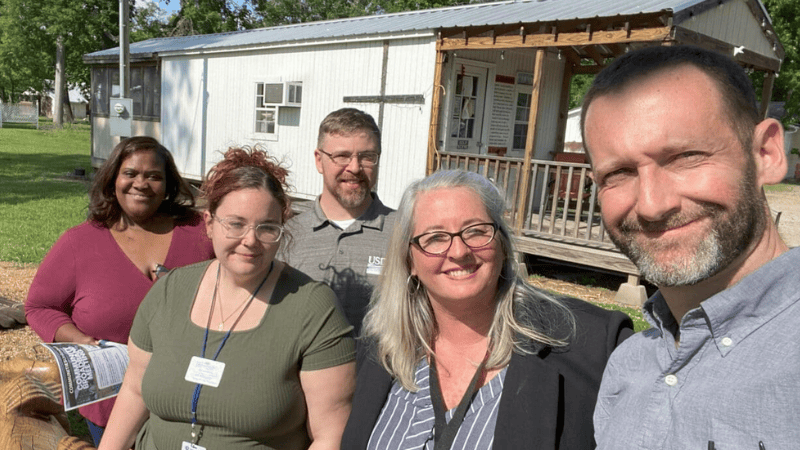
Communities Unlimited works alongside rural communities in persistent poverty to turn approved plans into real connections. If your community in Texas wants to understand where it stands in the BEAD build, map its water and sewer lines before crews dig, or build the digital skills and adoption piece, connect with CU’s Broadband team.

