


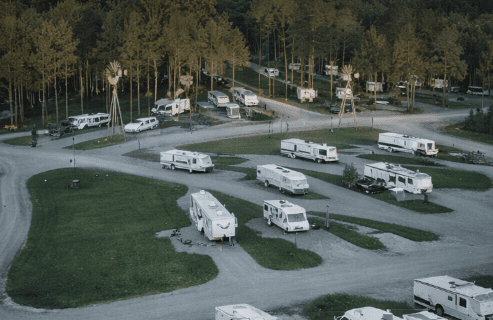
TJ O’Rourke knows water like the back of his hand. He’s an engineer and has drilled wells, built systems, and put up windmills in places that had nothing. Perched along the edge of the rugged plateau known as the Highland Rim in Tennessee — characterized by rolling hills and limestone terrain — 187 feet below the hilltop where his RV park sits, there’s a well that produces what he calls the best-tasting water he’s ever had.
But knowing you have good water and being able to prove it — legally, documentable, to the satisfaction of state regulators — are two entirely different things.
“It was a bureaucratic storm,” O’Rourke said. “There was so much paperwork, and I couldn’t see the forest for the trees.”
Country Livin RV Park, a 49-site campground tucked into rural Middle Tennessee in Ethridge — part of Lawrence County and home to one of the largest Amish communities in the South — had the water. What it didn’t have was a roadmap through the regulatory requirements of the Tennessee Department of Environment and Conservation (TDEC). O’Rourke found himself fielding one form after another, each requiring something else first, with no clear picture of what the finish line looked like or how to reach it.
That changed when Communities Unlimited (CU) entered the picture.
A Referral, a Site Visit, and a Plan
CU’s Community Infrastructure Team received a referral from TDEC in the summer of 2025. Last July, CU Consultant Annie Chiodo made the drive to Ethridge to meet with O’Rourke and TDEC — walking the property, assessing the water system, and beginning to map a path forward.
What followed was months of structured, methodical work alongside Country Livin: establishing a Cross-Connection Control Plan, building out Operations and Maintenance documentation, conducting a source water assessment, and preparing a Wellhead Protection Report. When TDEC determined the well’s source qualified as true groundwater under the influence of surface water, Chiodo relayed the implications to O’Rourke and helped him understand what additional safeguards were needed.
A Revised Total Coliform Sampling Plan was also required for Country Livin. Chiodo rewrote it to align with TDEC’s updated guidance, then made another site visit to walk the property with O’Rourke and certified operator John O’Rourke. During the visit, she photographed the treatment area, identified proper sampling point locations, and reviewed testing procedures and repair reporting in detail.
For O’Rourke, the assistance made all the difference.
“Annie made it digestible,” he said. “She turned it from a mountain of stuff into something doable. She put everything in order — what’s a prerequisite, what comes first. That structure wasn’t findable anywhere else.”
The Stakes Were High
Water isn’t just an amenity for an RV park. It’s the foundation of the entire business.
All 49 connections depend on it. Guests need water for drinking, cooking, bathing, flushing toilets — basic, daily functions. Without a safe and compliant system, an RV park can’t legally operate. Even if it tried, it wouldn’t be viable. No water means no customers, no revenue, and ultimately no business.
“It enables us to operate, honestly,” O’Rourke said. “Water is essential in an RV park, and we weren’t going to have water.”
That wasn’t a distant risk — it was an operational shutdown scenario.

The stakes are even higher in a place like Ethridge. It’s a small, rural community shaped by rugged terrain, where utility infrastructure isn’t always a given. There’s no easy fallback, no centralized system to plug into if something goes wrong. As O’Rourke put it, they’re lucky to have electricity — and now, he added, they have some of the finest water anywhere.
The system filters and UV-treats the water multiple times before it ever reaches a tap — removing sediment and impurities while using ultraviolet light to neutralize bacteria and other microorganisms — so what comes out is clear, safe, and consistent.
Even before the compliance process began, guests were stopping to fill jugs straight from the source. What changed wasn’t the water itself — it was the ability to document it, verify it, and stand behind it within a full regulatory framework. The same system that once sat in uncertainty is now tested, accredited, and fully compliant by TDEC.
“There was a time we didn’t think we were going to get there,” O’Rourke said. “Our system was always good, but now it’s documented. It’s not just what we think — it’s verified. So we’re grateful.”
On top of that, the RV park now submits monthly operational reports on time to TDEC, maintains an accredited testing schedule, and has a network in place to keep the system running correctly into the future.
Country Living, Without Compromise
When the compliance process first began, O’Rourke had a specific worry — that meeting regulations would mean losing what made Country Livin’s water special in the first place.
“I was worried they were going to make me turn it into ‘city water,'” he said, “and nobody wants that out here. We want to keep that country living feel. That’s what adds to our charm.”
That didn’t happen.
Working alongside CU, Country Livin kept its well water pure and met every requirement — without sacrificing what guests come for. Country Livin offers visitors a slice of a slower, more intentional way of life — with the added assurance now that the water coming out of the tap has been tested, documented, and verified safe.
O’Rourke was quick to give credit to Annie Chiodo and Communities Unlimited for the assistance.
"Annie was our champion — like an icebreaker cutting through icebergs for us. She didn't do the work for us — she helped us navigate it. That's what made this work."
— TJ O’Rourke, Country Livin RV Park

