


For decades, the people running the Village of Dry Prong’s water system in Grant Parish, Louisiana — a small community near Alexandria — worked from memory. When a valve needed to be located or a line traced, someone who had been around long enough just knew — or went looking. There were old blueprints and institutional knowledge, but no comprehensive map.
That reality became even more fragile in a system where staffing has long been a challenge. When someone left — or passed away — knowledge often left with them. New operators came in with little to go on, and the cycle of relearning would start again.
“When transition happened, we had to learn it on our own,” said Lisa Locker, the village clerk who has long served as the institutional memory of Dry Prong’s utilities. “Go out there and find things ourselves. We made it work, but it was a lot harder.”
That’s the situation Anthony Roe stepped into in October 2025. The previous operator had passed away, leaving no transition and no one to walk him through the system.
“I was having to learn the system from scratch,” Roe said. “The blueprints are old, and I was struggling with that. But mapping it out and actually seeing everything in the field — all the valves, hydrants, meters — it finally tied it all together for me.”
The GIS mapping project that followed in early 2026 didn’t happen by chance. It started with a conversation between Roe and Chris Brunson — Louisiana State Coordinator for Communities Unlimited’s (CU) Infrastructure Team — who had known the system long before stepping into that role. Brunson worked as a water operator in Dry Prong from the mid-1980s to the mid-1990s, and after joining CU in 2001, remained closely connected to the village, working with Dry Prong off and on in various capacities.
City
Dry Prong
State
County
Grant
District
LA-6
Funding
Department
Outcome
“Chris worked here before any of us did. So when we needed somebody who knew this system, we knew he was the man.”
— Lisa Locker, Village of Dry Prong
That long-term relationship has taken different forms over time — from helping the village navigate drinking water compliance and Louisiana Department of Health (LDH) violations to supporting wastewater improvements. His early support included helping complete a wastewater discharge permit application, saving the system significant engineering costs. In 2022, that work also included helping plan and secure bids for the rehabilitation of the village’s main sewer lift station, reducing costs enough for the project to move forward using available funds.
By early 2026, the need had shifted again — this time toward rebuilding institutional knowledge.
Over three days in March, Brunson and CU Geographic Information System (GIS) Project Manager Don Becker walked every inch of Dry Prong’s system alongside Roe, capturing data points for every valve, hydrant, meter, and line in the village. At the same time, Roe was being trained to use the system himself.
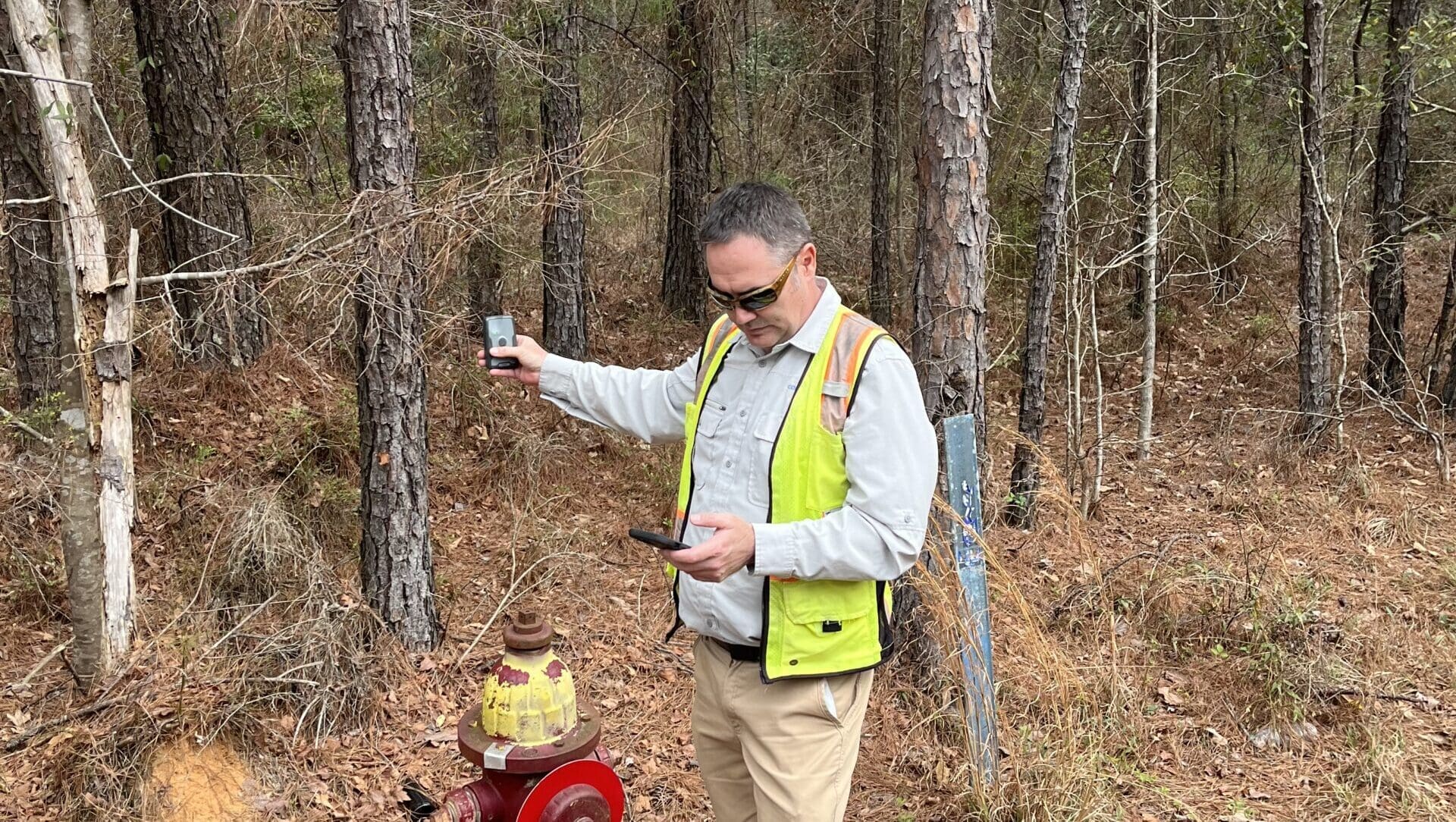
“The first day, Chris, Don, and I all went out together,” Roe said. “Don was teaching me how to capture points and enter data. The second day we spent about half a day together, and once he felt confident I had a grasp of it, he and Chris went off on their own and sent me off on my own — kind of a trial run.”
By the end of the third day, the entire system had been mapped. The final version was reviewed and approved in April 2026, which will give Dry Prong a complete, working picture of its infrastructure. The system now has both digitized and printed maps available to them developed by CU.
“I cannot tell you what a burden that lifted off my shoulders,” Locker said. Before the mapping project, she was the one showing new operators where things were. After it, she didn’t have to be.
Now, that map lives in Roe’s pocket.
“It’s an unlimited resource,” he said. “I can pull up everything on my phone, document work as I go, and make sure someone else can come in and pick up where I left off.”
The system also connects to Louisiana 811 one-call locating, helping prevent damage when other utilities excavate nearby — a huge benefit in a rural area where mistakes can be costly.
More than anything, it represents a shift away from dependence on any one person’s memory.
“I don’t want to be a single point of failure for this community,” Roe said.
Dry Prong, a village of just under 500 residents, is now beginning early conversations about regionalization — potentially connecting to a larger neighboring system to address long-term staffing and sustainability challenges.
What that future looks like is still uncertain. But for Locker, the impact of the last several years is not.
“(Communities Unlimited) has been a godsend to us. Anytime we call, they’re willing to come. They’ve always been here for us.”
— Lisa Locker

