


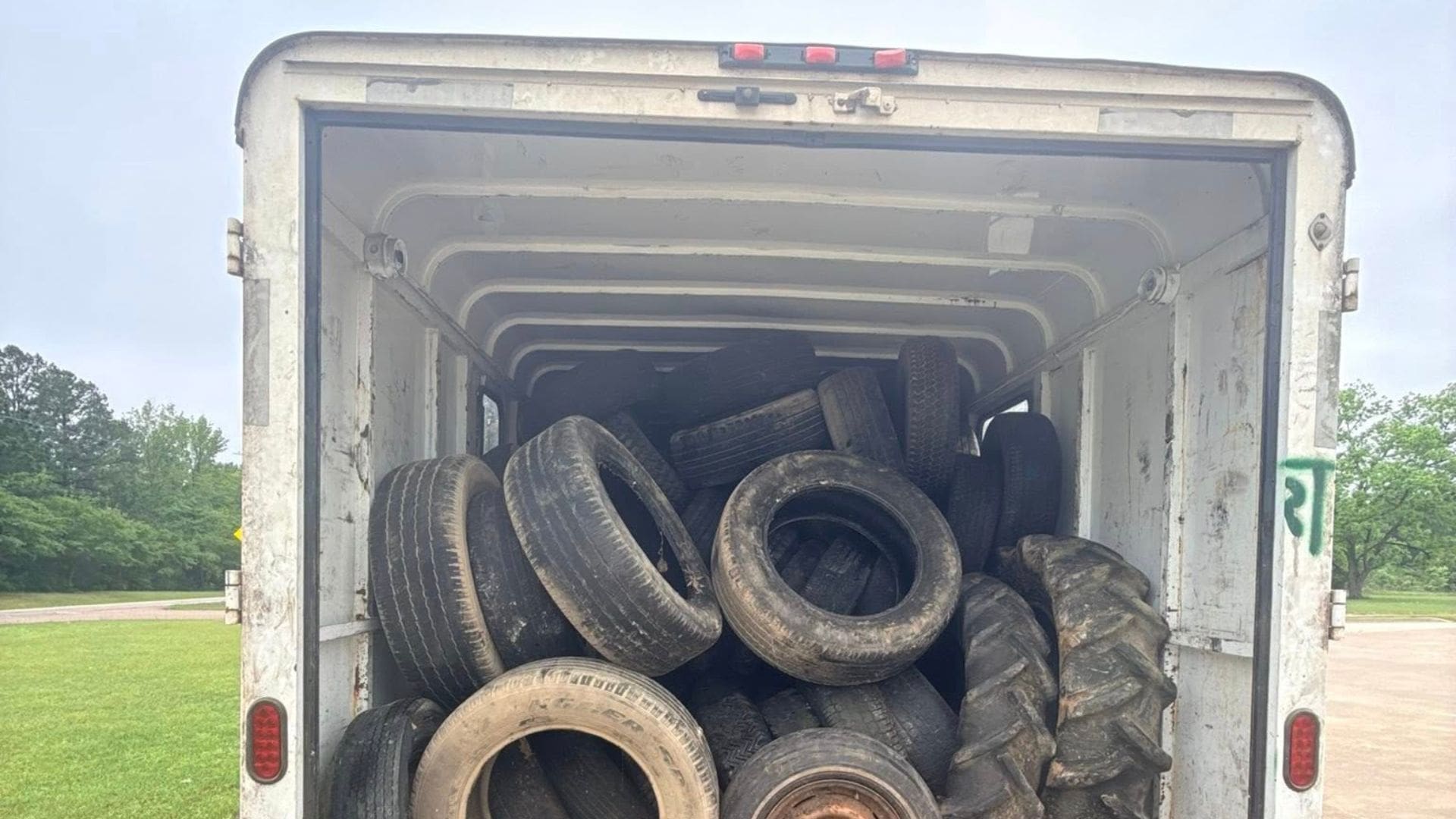
On April 25, 2026, the City of Queen City, Texas, opened a free tire disposal event in their parking lot. The line was already wrapped around the building and stretching toward Highway 59 before the 10 a.m. start time. By 11:05 a.m., 350 tires had been loaded into a trailer. By noon, the event had wrapped, and the demand was so far beyond what anyone had anticipated that Communities Unlimited (CU) arranged a second trailer run. That one filled completely too, two days later.
Queen City, in Cass County in the far northeast corner of Texas, didn’t have a tire problem. It had a systems problem. And when the barrier came down for one day, the community showed exactly how long they’d been waiting for it.
A Gap That Stays Quiet Until It Doesn’t
Proper disposal of waste tires is more complicated and more regulated than most people realize. Used tires can’t simply be hauled off in a pickup and dropped somewhere. Anyone transporting waste tires in volume is required to hold a license as a transporter through the Texas Commission on Environmental Quality (TCEQ) and must maintain a legal manifest documenting where every tire came from and where it’s going. Facilities that accept them must be permitted.
City
Queen City
State
County
Cass County
District
TX-1
Funding
Department
Outcome

The chain of custody is real, and it exists for good reason: illegally dumped or improperly burned tires pose serious environmental and public health risks, contaminating soil and water and creating breeding grounds for mosquitoes and pests.
Stephen Wente, owner of Minty’s Tire Transport in Bloomburg, a few miles down the road from Queen City, knows that chain well. As a registered transporter, he’s required to bring every tire to a permitted processor and maintain documentation at each step.
“The money passes through three different businesses,” he said. “The generator, that’s the tire shop, the transporter, and the processor. Each one is its own business and handles its own money.”
That structure keeps the process legal and accountable. It also makes it expensive.
The closest licensed processing facility to Queen City is Arklatex Tire Processing in Linden, 17 minutes away and two cities over. Each load delivered there is counted, logged, and handled according to state regulations, then shredded and used as fill material in reclaimed industrial sites: stabilizing land that’s covered with soil and replanted, often with trees. But proximity on a map doesn’t mean access in real life. Legal disposal costs money per tire. It requires a large enough vehicle to haul them.
It requires knowing where to go and how the process works. For many households in a small rural city, those barriers stack up fast. Some customers, Wente noted, see the disposal fees at the tire shop and simply decide to hold onto their tires. Others turn to unlicensed haulers who undercut the market by dumping illegally for free. The result is tires accumulating on back porches, in ditches, along fence lines, and on inherited land, not because people don’t care, but because the legal option was never built to be easy or affordable for them.
That’s the gap the CU Sustainability Team, working alongside the City of Queen City, set out to close.
How It Came Together
Early conversations centered around solid waste, where discarded tires surfaced as a need. City staff knew it was a problem, but they didn’t have a clear path forward or the internal capacity to solve it.
While those conversations didn’t immediately lead to a solution, they laid the groundwork.
CU’s work in the community continued through a Geographic Information System (GIS) mapping project in July 2025, which documented the city’s water and wastewater infrastructure. That engagement — and the trust built through it — is what made the tire disposal effort possible.
CU Area Director for Field Operations DeAnna O’Malley carried forward what had already been discussed. When the opportunity came to act, the need was clear, and the groundwork was already in place.
O’Malley reached out to County Judge Travis Ransom, who connected her with Arklatex Tire Processing in Linden. From there, Arklatex provided a list of licensed transporters, and O’Malley connected with Minty’s Tire Transport, the closest option to the area.
By the time the event came together, the relationships and logistics were already in place.
Minty’s dropped off a trailer. CU coordinated the event. The city provided the location and made one request: CU staff the event, as they didn’t have the personnel available on a Saturday.

The Tire Event
DeAnna and her husband, Tommy, arrived at 9:18 a.m. The event wasn’t supposed to start until 10.
There were already 12 cars in line, and by the time they walked around the building to assess the setup, the line had wrapped the entire structure and reached Highway 59. There was no time to make a plan. They just started working.
Tommy climbed into the trailer. DeAnna managed the crowd. Most residents unloaded their own vehicles, but Tommy loaded and stacked nearly all 350 tires himself with help from a few volunteers, many thrown by hand, while DeAnna directed traffic, answered questions, and kept the line moving.
At 11:05 a.m., the trailer closed. The event that was planned to run all day was done. A second trailer run was arranged for that Tuesday, and it filled completely as well.
“Events like this give the public a chance to do the responsible thing with their tires,” Wente said, “and do it for free.”
What It Means to Clean Something Up
A tire disposal event is easy to underestimate. But what it does, for the people who showed up, is give them their land back.
Tires take up serious physical space. A property with 60 illegally dumped tires on it can’t be mowed or maintained. For families navigating heirs’ property, land that passed without a clear title after a loved one’s death, that compounds an already difficult situation. Clearing the tires doesn’t just tidy a yard. It removes a barrier to using and stewarding land that belongs to a family.
There’s also the environmental reality that accumulates quietly over time. Wente points to mosquitoes as the most direct and consistent threat. Because of a tire’s insulative properties, water trapped inside almost never evaporates, even in summer heat.
“I’ve been on cleanups where tires had been sitting for years and the water inside looked two years old,” he said. That standing water becomes a shielded, stable breeding ground, protected from wind and predators. Remove the tires, and you remove the habitat.
And there’s what it signals to a community when a problem that’s been sitting for years actually gets addressed. People showed up in numbers no one expected because the need had been there, unmet, for a long time. It was relief that something was finally possible.
“These community events do something that individual action can’t,” Wente said. “They rally people around a shared purpose and get more done than anyone would have managed on their own.”
Amanda Wiley, City Administrator for Queen City, said the event delivered results the city couldn’t have achieved on its own.
“The City of Queen City would like to thank Communities Unlimited for their generous grant, which made our tire disposal day possible,” Wiley said. “Their support allowed us to remove a significant number of discarded tires, improving the appearance, safety, and environmental health of our community.”
"We appreciate their commitment to rural communities and their partnership in helping us create a cleaner, healthier place for everyone."
— Amanda Wiley, City of Queen City
Queen City showed up. Nearly 700 times over.

